

From Ghosts to Ancestors
Intergenerational trauma and confronting ghosts in the nursery
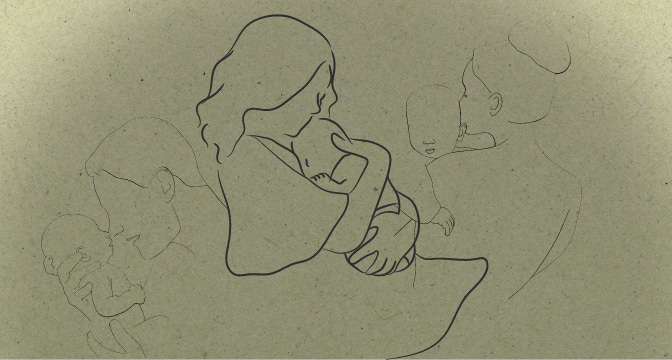
In every nursery there are ghosts.
So begins Selma Fraidberg’s seminal text, “Ghosts in the Nursery: A Psychoanalytic Approach to the Problems of Impaired Infant-Mother Relationships,”— essential reading for any perinatal therapist, and foundational to our understanding of intergenerational relational trauma, and how to treat it.
The concept of ghosts in the nursery rests on the understanding that, for better or worse, parents tend to pass along the parenting that they themselves experienced as children. The attachment blueprint formed by our relationships with our earliest caregivers influences how we relate to friends, partners, and— ultimately— our children, should we choose to have them. These ghosts are traumas or ruptures in that attachment blueprint that are often unconscious and reappear across generations. They are the pains, losses, and sorrows that filter through into the parenting we received, and our parents received.
But, of course, we’re not destined to repeat the mistakes of our ancestors. Indeed, Fraidberg and her colleagues posit that by bringing these ghosts into consciousness— by telling the trauma narrative— we can identify unhelpful patterns in our and our forebears' parenting and make different choices.
In discussing ghosts in the nursery, I often think of a former patient who we’ll call Stacy. Stacy was an OB resident in her mid-thirties, originally from the midwest, and married to a man, who we’ll call Ben. When Stacy and I first met, she was approximately 22 weeks pregnant with her first child and acutely depressed.
Stacy had been in and out of therapy her entire adult life. Her biological father left her and her mother soon after she was born, and Stacy didn’t see or hear from him again until she was in her early 20s.
When Stacy was five, her mother remarried a man who was antagonistic and abusive. Stacy recalled one night when she was awoken by her mother and hurried into her mother’s bedroom. Bleary eyed, scared, and confused, Stacy watched her mother barricade the bedroom door with a dresser as her stepfather screamed and threatened to break down the door. Her mother called 911, but her stepfather ran off before the police arrived. Like most victims of domestic abuse, Stacy’s mother never filed charges.
As Stacy got older, her stepfather’s behavior became increasingly volatile until she too became a direct target of his antagonism. When Stacy was in high school, her stepfather grabbed her by her hair and threatened to choke her. That was the final straw for Stacy’s mother; she filed a restraining order and he was removed from the home. Stacy never saw or heard from him again.
After high school, Stacy enrolled in a local university but continued to live at home with her mother. It was then Stacy experienced her first depressive episode. She connected with a therapist through her university and began the difficult work of unpacking the abuse she witnessed and experienced first hand.
She started taking an SSRI and was additionally diagnosed with ADHD— not uncommon for those who have experienced childhood trauma and, for women, very often diagnosed in early adulthood.
With her depression and ADHD treated effectively, Stacy flourished. She met and married Ben, moved out of her mother’s home, and completed medical school. For residency, she matched with a New York area hospital, and she and Ben moved to the City.
The move to New York was difficult for Stacy. It was the first time she’d lived outside of her hometown, and the demands of residency left her completely burnt out. She struggled with the hospital culture and felt increasingly out of her depths. When she learned she was pregnant, she stopped taking her ADHD medication, which made work more difficult. She became increasingly anxious and overwhelmed. By the time Stacy and I began our work together, she was approaching her third trimester, riddled with anxiety, and severely depressed.
During our first session, we decided Stacy would start her maternity leave early in order to more fully engage in treatment. She*began working with a reproductive psychiatrist (we’ll call her Dr. M) who recommended Stacy resume her ADHD medication and go up on her SSRI. Dr. M explained that during pregnancy, the body metabolizes medications differently, and higher doses are often needed to maintain the same effect.
As a doctor, Stacy knew that at this stage in her pregnancy, the risks her untreated depression posed to herself and her baby far exceeded those associated with her prescribed medications. Still, she was hesitant. She feared her husband would not approve; that he would think she was exposing their baby to undo harm; that he would conclude she wasn’t trying hard enough to beat the depression on her own; that he would see her reliance on medication as proof that she was an unfit mother; that he would leave her.
Ultimately, Stacy agreed to adjust her medications if her husband was provided the opportunity to meet with and ask questions of Dr. M. The day of the meeting, Dr. M walked Ben through to Stacy’s diagnoses of anxiety, depression, and ADHD, her recommended course of treatment and the associated risks. When she finished, she asked Ben if he had any questions or further concerns. “No, that all makes sense to me,” he replied.
Ultimately, Stacy agreed to adjust her medications if her husband was provided the opportunity to meet with and ask questions of Dr. M. The day of the meeting, Dr. M walked Ben through to Stacy’s diagnoses of anxiety, depression, and ADHD, her recommended course of treatment and the associated risks. When she finished, she asked Ben if he had any questions or further concerns. “No, that all makes sense to me,” he replied.
There was silence as we waited for him to say more. After hearing all of Stacy’s fears about how Ben would respond to increasing her medication, Dr. M and I were expecting him to be a hard sell. “Stacy," I asked, "I wonder if you can share with Ben some of the concerns you’ve discussed with me and Dr. M.”
Stacy turned towards Ben and her voice wobbled as she said, “I just don’t want you to think that I’m putting our baby at risk or that I’m not taking care of her or I’m not trying hard enough to get better. Everything’s about to change and I just don’t want you to think that I’m not a good enough mom.”
Ben seemed genuinely stunned. “I don’t think that at all,” he said. “You’re going to be an amazing mother— you already are. And you know your body and I trust you and you have a team of people who specialize in this and you’re going to be fine. I see how hard you’re trying and if you need more medication, that’s okay. I think it’s just something that some people need and that’s fine. You’re a doctor; you know that.”
There was a pause as Ben’s words hung in the air.
“Stacy,” I asked. “What’s it like to hear this from Ben?”
“It feels good,” she said. “Like I’m relieved, but I don’t know if I can really take it in.”
After the meeting with Ben, Dr. M, and me, Stacy restarted her ADHD medication and titrated her SSRI to the recommended dosage. Bolstered, by the changes to her medication, we continued to unpack Stacy’s fears related to her medication and her marriage. Stacy shared that even though her pregnancy was planned and desired, from the moment she received a positive test, she’d been terrified that the birth of their child would mean the dissolution of their marriage. Indeed the ghost of her biological father abandoning her and her mother when she was an infant was reemerging as Stacy herself became a mother. Deep within, her body and psyche were primed to expect paternal abandonment with the birth of her child.
Moreover, Stacy had spent a lifetime blaming her infant-self— her mere existence— for the dissolution of her parents' marriage. In her mind, if she had never been born, her father never would have left, and her step-father never would have entered her mother’s life. The ghost of her father’s abandonment had led Stacy to conclude that her being born had ruined her mother’s life, and now she was terrified the birth of her own child would do the same.
Much of psychotherapy is about turning ghosts into ancestors. Identifying their source, telling the narrative, and bringing it to consciousness allows the ghost to pass on, and simply become a part of our history. For the remainder of our work together, the ghost of her biological father’s abandonment served as the focus of our treatment.
We revisited what Stacy remembered of her father's abandonment, her mother’s devastation and grief. We explored Stacy’s internal narrative of the reasons for his abandonment and the stories her mother had told her. Bringing these narratives, beliefs, and fears into consciousness led to significant relief in Stacy’s depressive symptoms. Though the fear of abandonment persisted, she was now able to identify them for what they were. She was able to discuss them openly with Ben and, in turn, he reassured her of his commitment to her and the family they were building together. The ghost of paternal abandonment would not haunt their child; it would simply be a part of her family’s history.
As she approached her due date, Stacy began to discuss the ways she hoped to parent differently from her own mother. She wanted her child to feel loved and supported as she had felt loved and supported by her mother. But she didn’t want her child to have to worry about her in the ways she worried about her own mother; she wanted her child to see her as strong, capable, and brave, and she wanted to see herself that way, too.
The work of confronting Stacy’s ghosts didn’t end with the birth of her child, nor did it start when her child was conceived. More than a decade before, Stacy had begun to do tremendous work confronting the ghosts of her stepfather’s abuse. Indeed, if she had not done this work then, I don’t believe we would have so easily accessed the original trauma of her biological father’s abandonment. For Stacy— and for all of us—this work takes a lifetime and is never truly complete.
Indeed, in every nursery there are ghosts. And still this does not mean our children are destined to grapple with their ancestors’ unfinished business. With insight and retelling the trauma narrative, we can write a different story as our ghosts go from haunting us to simply being a part of our history.